
Introduction
Improving student performance has become a top priority for every school—whether small or large. With increasing competition, CBSE/ICSE compliance, progressive teaching methods, and rising parent expectations, schools must rely on data-driven decisions rather than manual guesswork.
This is where a School ERP system becomes a powerful game-changer. Modern ERPs like Chanakya ERP help schools track academic growth, analyse performance trends, and offer insights that support teachers, parents, and administrators.
In this blog, you’ll explore how a School ERP enhances student performance analytics, why it matters, and how your institution can benefit immediately.
1. Real-Time Academic Tracking for Every Student
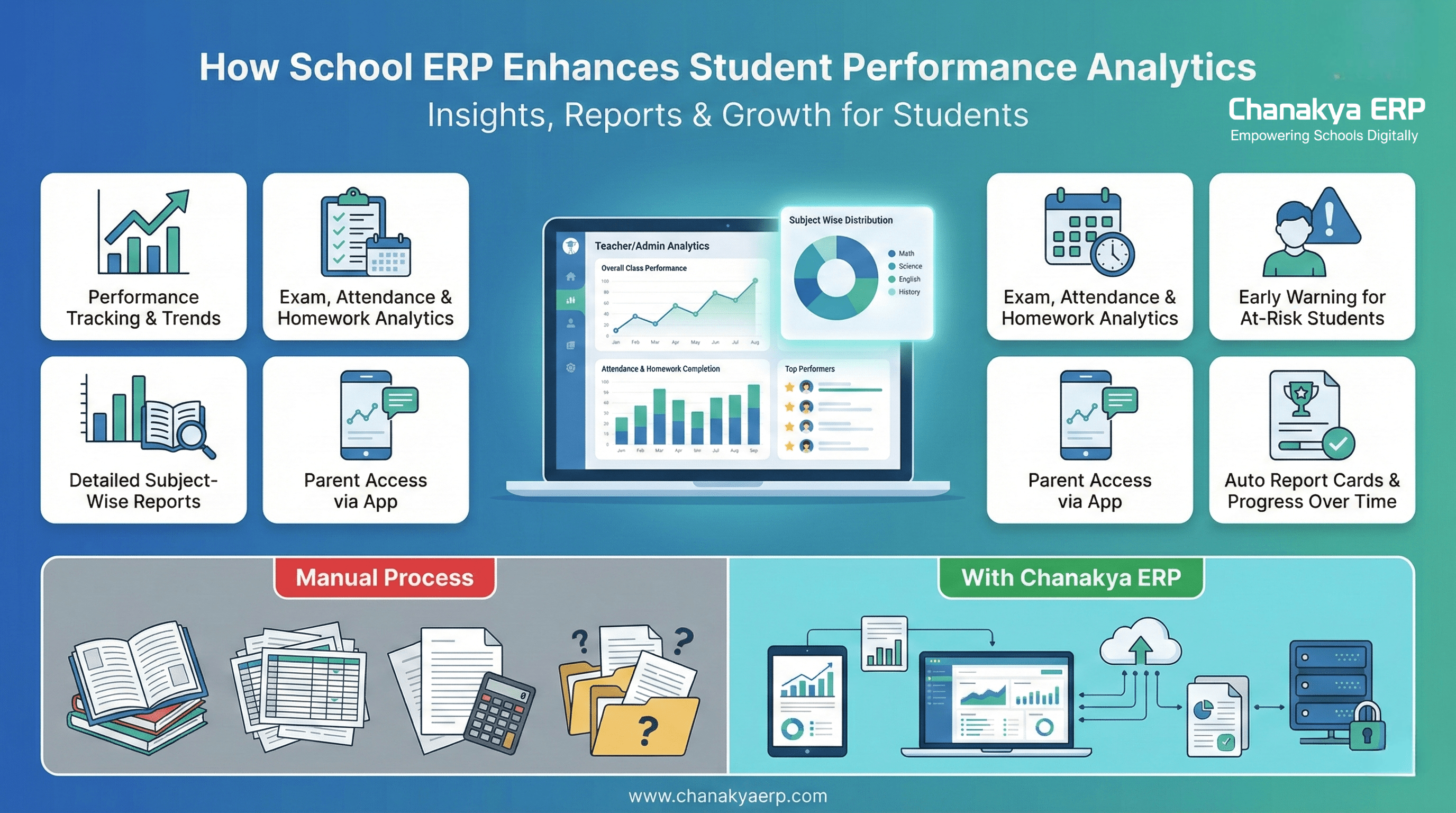
A School ERP enables continuous and transparent monitoring of academic progress. Instead of checking individual notebooks or Excel sheets, teachers and admins get instant visibility into:
-
Marks and grade performance
-
Subject-wise strengths and weaknesses
-
Homework completion patterns
-
Skill and behavioral assessments
Modern platforms like Chanakya ERP show analytics dashboards where teachers can identify students who need extra support — early and accurately.
? Explore complete features:
School ERP Features
2. Automated Reports & Visual Dashboards
Manual report creation is prone to errors and consumes hours of teacher time.
A School ERP system simplifies this through:
-
Automated grade cards
-
Progress charts and graphs
-
Attendance vs performance analytics
-
Monthly academic summaries
-
Customised CBSE/ICSE-aligned reports
These reports give clearer insights, reduce calculation mistakes, and improve the quality of academic evaluation.
3. Predictive Insights Through Data Patterns
Advanced School ERPs use aggregated data to identify patterns like:
-
Declining performance in specific subjects
-
Students at risk due to irregular attendance
-
Sudden performance dips
-
Consistency issues in specific topics
This helps academic coordinators implement early interventions, schedule remedial classes, and allocate resources more efficiently.
4. Attendance-Based Performance Insights
Studies show that a drop in attendance often correlates with poor performance.
A School ERP connects:
-
Daily attendance
-
Subject attendance
-
Leave patterns
-
Monthly attendance trends
This allows admins and teachers to detect issues early and take corrective actions.
? Explore smart attendance options:
Face Recognition Attendance System
Wireless Biometric Attendance
5. Homework, Assignment & Exam Analytics
Tracking homework and exam performance manually is tough.
A School ERP gives analytics on:
-
Homework submission patterns
-
Timely vs delayed submissions
-
Topic-wise performance
-
Exam score comparisons
-
Student competitiveness
This helps teachers improve teaching strategies and students understand exactly where to improve.
6. Parent Collaboration Boosts Student Progress
When parents receive timely updates through a School Mobile App, they stay more engaged in their child’s academic journey.
An ERP ensures parents can track:
-
Marks & report cards
-
Attendance
-
Homework
-
Class tests
-
Notifications
-
Behavior notes
Better parent-teacher collaboration results in higher student performance.
? Explore the app:
School Mobile App
7. Performance Comparison Across Classes & Terms
ERP analytics allow schools to evaluate:
-
Class-wise academic results
-
Batch performance trends
-
Year-to-year improvement
-
Teacher performance linked to outcomes
Admins can use this for planning teacher training, modifying teaching approaches, and improving curriculum delivery.
8. Centralized Academic Data for Decision-Making
With all performance data stored digitally, schools benefit from:
-
Better planning
-
Improved academic strategies
-
Data-backed decision making
-
Reduced paperwork and errors
-
Faster communication
This leads to continuous academic improvement and a smarter learning environment.
How School ERP Boosts Student Performance Analytics
| Feature | Manual System | School ERP (Digital) |
|---|---|---|
| Report Generation | Slow & error-prone | Instant & accurate |
| Performance Tracking | Limited | 360° analytics dashboard |
| Attendance Impact Analysis | Not possible | Fully automated |
| Parent-Teacher Collaboration | Inconsistent | Real-time updates |
| Predictive Analysis | None | Smart insights |
| Comparison Analytics | Manual & complex | One-click reports |
FAQs
1. How does a School ERP help improve student performance?
It provides real-time analytics, automated reports, early warnings, and performance insights that help teachers and parents act quickly.
2. Can a School ERP track individual student progress?
Yes. ERPs track marks, attendance, assignments, behavior, and overall academic improvement for each student.
3. Does analytics improve parent engagement?
Absolutely. Parents receive real-time notifications and insights, enabling better support at home.
4. Is student performance analytics helpful for teachers?
Yes. Teachers can identify weak areas, allocate time better, and personalize teaching approaches.
5. How is Chanakya ERP better for analytics?
Chanakya ERP offers intuitive dashboards, accurate reports, mobile app insights, and data-driven decision-making tools.
Conclusion
Student performance analytics are essential for modern education. With Chanakya ERP, schools gain complete visibility into attendance, academics, exams, and behavior — all in a single, powerful platform.
If your school wants to upgrade its teaching quality and boost student outcomes, a School ERP is no longer optional — it’s necessary.
? Learn more about our features:
School ERP Features
? Explore affordable pricing plans:
Pricing Plans
? Ready to upgrade your school?
Request a free demo today!